Showing posts with label wrigley field. Show all posts
Sunday, June 19, 2016
My Dad and Baseball and Father's Day
My dad died two and half years ago. It's an ache I carry with me every day, although I have grown used to the pain, and, like a bad knee or a bad back, I don't really notice it anymore unless it gets poked.
After my parents divorced, my dad and I spent awkward weekends in his studio apartment in Chicago, bored out of my mind and counting the minutes until I could go home. I was miserable.
Then, when I was 14, I discovered baseball. I discovered Mark Grace and Ryne Sandberg, Robin Ventura and Craig Grebeck. And I discovered that baseball was beautiful and complex and perfect, and that the players were stone-cold foxes. But the best thing I discovered was that my dad and I finally had something to talk about and do together. Those miserable weekends became something I looked forward to. My dad, who was totally sexist, began to value my baseball opinion. We talked well into the night.
He took me to my first Cubs games, a doubleheader against the Reds. I wasn't prepared for the beauty. We walked in under the big red marquee, and we walked through the dark tunnel, and then up the stairs into the bright sunlight and saw the greenest green my eyes have ever seen. Our seats were right behind home plate, where I could hear every expletive muttered by the players and the blue of their pinstripes was so vivid against the whites of their uniforms. I fell in love that day, and I have been in love ever since. Later that season, he took me on the field at Wrigley for some kids event. I touched the ivy. I stood on first base and pretended I was Mark Grace. I ran the bases and had one of the greatest day of my life.
My dad and I became very close, and remained close until his death. When I moved to Minnesota for college and stayed there for a decade after, he called me and updated me on everything baseball. For a while, I grew away from the sport, following it only peripherally because I was focusing on college and life. We watched the Cubs in the 2003 playoffs together, despite the distance, by talking on the phone the whole time. I was crying when the Bartman incident happened and everything failed, but he was explaining to me that this was the life of a Cubs fan. He had been through it in 1969 and it taught him to always be cautiously optimistic when it came to the boys in blue.
As my dad got older, he preferred staying home to going to the ballpark. I could get him to go to Comiskey sometimes, but he never wanted to go to Wrigley. So we watched baseball on tv, and shared memories, and talked about the players we liked best. When I bemoaned losing Theriot, he talked up Castro. When Kid K walked off the field that last game, I called my dad, crying, and he said I'd love again. He called after every Steve Clevenger hit or Blake Parker strikeout. When Robin Ventura was named manager of the White Sox, he called me incessantly until I picked up. I always called him after meeting a baseball player, and he always wanted to hear every detail and made me repeat everything. He was always the first one to give me baseball news, but he was also the first one I called to talk about my baseball adventures.
Every Father's Day, I picked up a pizza and went to his house to watch baseball all day. It was our tradition for almost 20 years. Since he's died, I spent those first two Father's Days at baseball games, and I'd get a slice of pizza and sit alone and watch the game and miss my dad.
This year, I decided to hang out with my stepdad and the rest of the family. I was beginning to regret my decision when John Mallee, a wonderful man and the Cubs hitting coach, offered my friends and I on-field batting practice tickets and seats to Saturday's game against the Pirates.
It was surreal. I was standing there, the day before Father's Day, mingling with Kris Bryant and Billy Williams, Wrigley's dirt drifting in my sandals. Our seats were behind home plate. I was back in time. I wanted to call my dad to share with him this unexpected gift. He would have understood that the awe I felt as a child standing on that field was the same awe I felt 20-some years later, standing on that same field. I loved every second of yesterday, and I know he wasn't literally with me, but I think he had a glimpse from heaven of the heaven I felt yesterday.
He would've loved this Cubs team so much. He would've loved Maddon's management style. He would've loved watching Arrieta pitch and Bryant hit. I have wished many times that my dad could watch this team with me, but yesterday, I felt like he did. As crazy as that seems, I felt closer to him on that field than I have felt since I lost him.
Baseball is the connection between my dad and me. I will always have my dad to thank for my love of baseball, but now I have John Mallee to thank for giving us that Father's Day moment.
I miss you, Dad.
Tuesday, February 16, 2016
The death of a friend
I was driving home from work, stopped by a train, and was glancing through my e-mails. I saw the subject: "Ernie died!!!!"
Ernie? Ernie who?
And then I knew.
I've written before about the culture of us autographers (http://baseballgirl23.blogspot.com/2013/08/my-secret-shame_7.html). We're a strange bunch. We see each other 6 months of the year, and we form alliances, much like you'd see on Survivor, and also, much like Survivor, we betray those alliances when we get a better offer. Graphing is all about us, how much we can get and who we can get. We hate when a guy signs for just one of us, unless we are the one, and then we gloat.
But really, I am not hardcore. I don't care enough. I pout when someone I really like passes me up. But I don't lose sleep over missing someone, even a big name. The guys I usually want the most are ex-Cubs or ex-Twins or someone I want to meet because he has a great beard. I don't care about the big names because I will never sell anything and because I have no one to brag to except the guys I graph with, and, really, they won't let me brag.
Most of the guys who do this don't like me. They humor me because they know I'll help them identify the players and bring the Twins players over and because sometimes the players only come over because they see the oddity of a woman standing amidst the grown men. But they talk about me behind my back and make fun of the way I squeal with delight and excitement when I see the players. Usually, unless I see one of my friends, I try to stay invisible, hiding behind the legs of Billy Williams, trying to see if a cab is coming.
There used to be another woman who came out with her autographs. Sheila was much older in an ambiguous way. Sometimes I thought she was 50. Sometimes I thought she was 90. She was unorganized but passionate. Sometimes she would limp up to a player, only to spill all of her cards out in a spectacular mess. But she knew almost every player and would trot after them in a way that was so pathetic that the players would often think twice about passing her up, double back, and sign for her. She talked and talked and talked, often to herself, sometimes to other people. She looked unshowered, unkempt. I don't think I ever spoke to her. Not because I'm snobby about that stuff, but because, with the exception of two people, I don't trust any of these guys. I didn't know if her homeless look was just a schtick or if she really was mentally ill. I didn't want to form an alliance with her.
About a year ago, at Cubs Convention, I heard Sheila died. She was a cashier at a grocery store, and she just dropped dead. It was shocking, but I suppose it shouldn't have been. She didn't look healthy ever. My friends teased me. "That's going to be you," they would say, and I laughed on the outside, but on the inside I was terrified. What if that was me? What if my death became the punch line for a group of graphers who had always made fun of me anyway? What if that was all I left behind?
I later heard about people buying cards from her "estate." It made my skin crawl, to think of strangers (or, maybe worse, those I'd stood collecting with) picking over my treasures, talking one of my siblings down in price.
The first time I saw Ernie, I was appalled. I know, I know, that's horrible, but I was trying to be invisible--remember? He was somehow both large and small at the same time, with just a few teeth, moving with a liquid slowness, the way a slug moves on the bottom of an aquarium. He talked loudly and incoherently, sharing stories of both success and rejection with the other old timers. His clothes were torn and stained and ill-fitting. I assumed he was homeless, or nearly so.
I saw him a lot, almost every time I was out. He was usually clutching just one baseball wrapped in a baggie and a blue pen. He didn't drive, just took the train to Wrigley or to the Cell, and usually sat outside the park waiting for the big names. He didn't care so much about all the little guys. There's a guy in Chicago, one of the biggest autograph dealers in the country, and he'd give Ernie 10-20 bucks if he bagged a big name. I didn't like that either, but then I started to think that the guy must be pretty hard up to stand outside all day for the possibility of 10-20 bucks.
He could be pretty aggressive, too. When a big name, like Jeter or McGwire, came by, he would press his way to the front. I think sometimes people stopped for him because they felt bad for him, but sometimes it was just his sheer wily nature, the way he would slip his baseball in deftly between two other people and get the autograph. One time he pressed up against my back to get Yu Darvish. I was so mad that I was seeing red. I didn't want this gross guy pressing up against me just to get a stupid autograph.
But when the crowd went down, he came up to me. "Hey, Alex," he said, and I was surprised he knew my name. "Did you get him?" He didn't ask in a mean way, or like he was annoyed. He seemed to genuinely care.
"Yes," I said, apprehensively, trying to figure out why he wanted to know.
"Oh, well, that's just great for you!" he said, and not sarcastically. Sincerely. "I missed him, but I guess I'll get him next time.'
After that, we were fast friends. For the next few years, he always greeted me at the park, always asked me before he asked any of the guys if I needed help getting an autograph. He always seemed glad to see me, not like he was annoyed that there was one more person out there to ruin his chances of success. He came to the park nearly every day. Some days, he just didn't look well, and he would find a place to sit in the shade, but usually he looked the way he always looked and stood around with us, angling for the best spot. Sometimes his adult son would come to the park and they would work together. They were nice people, really just nice to everyone.
I got used to seeing him, which is why it was so sad that he sat out the entire 2015 season after getting knee surgery. We all missed him and talked about him, saying he was on the DL for the season. We saw his wife, who was a vendor at Sox Park, and asked for updates.
"Oh, he's just so stubborn. Won't do his physical therapy." She told us he was always cranky because he was cooped up in the house. She spoke about saving her tips to buy him something, but I don't remember what. I knew they didn't have a lot of money.
His son came out to a lot of games as well, and we asked about Ernie. "Oh, you know Dad. He's always grilling me about who I got and telling me I should've gone for the big guys. I tell him, get better and come out there with me then."
Even though Ernie was gone, he was always with us. We talked and told stories. like the time Ernie was too lazy to walk inside the bar to use the bathroom and subsequently was fined for public urination. I think he talked his way out of it, but everyone told the story differently. We talked about the way he weasled in for autographs. We talked about how strange it was that he wasn't there.
I knew he had bad knees. I didn't know he had Stage 4 pancreatic cancer, but that's what took him.
My heart hurts. He was a good guy. No, I don't know much about his personal life, but he was part of my autograph family. He was the patriarch, or at least the weird uncle that everyone likes.
I hope he is not forgotten. But I know he won't be. His legend will live with all of us who graph and who knew him.
I scrolled through my thousands of pictures, and I don't have one single picture of him. I hope I find one and can add it to this post.
This one's for you, Ernie.
“He Is Not Dead"
by James Whitcomb Riley
I cannot say, and I will not say
That he is dead. He is just away.
With a cheery smile, and a wave of the hand,
He has wandered into an unknown land
And left us dreaming how very fair
It needs must be, since he lingers there.
And you—oh you, who the wildest yearn
For an old-time step, and the glad return,
Think of him faring on, as dear
In the love of There as the love of Here.
Think of him still as the same. I say,
He is not dead—he is just away.”
Sunday, April 20, 2014
Why I love that dump called Wrigley Field
I've touched the ivy. I've run in the outfield and kicked up infield dirt. I've stood in the same places where Ruth and Banks and Sandberg walked and ran and laughed. There's hardly a seat in that stadium I don't know. I've sat in the uppermost corner where you can see absolutely everything, small and far, but clear and true. And I've sat right behind home plate, so close that I could have touched the players if it weren't for the netting, so close that I could see the sweat beading the foreheads of the most beautiful people I have ever known. I've sat in the famous bleachers, listening to the heckling and trying to catch the balls during B.P. I've seen it all from everywhere.
If you have never been to Wrigley Field, you cannot possibly understand the uniqueness, the beauty, the art of the field. It comes out of nowhere. You can't see it from the highway. You have to find it. You have to look for it. I love the feeling of walking down Sheridan past the fancy brick buildings where all the rich people live, and then it's there, almost like an afterthought, almost like someone shoved it in the middle of a neighborhood because it didn't fit anywhere else. It looks a little bit like it's bursting at the seams, pieces of it spilling onto the sidewalk, fans spilling onto the streets because there's nowhere else to walk.
On game days, the endless array of Wrigleyville bars are busy and loud many hours before the game, many hours after. Cubs fans like their liquor, probably a little more than they like their baseball. They can tell you what beers Wrigley has on tap, but will have trouble naming four active players on the team. I saw a shirt once that said "Win or Lose, We Still Booze." That is probably the best description of Cubs fans, fans that come in the third inning and leave in the seventh, after the historic stretch that is different than at any other ballpark. Harry Caray made "Take Me Out to the Ballgame" more than a song--he made it an entity of itself ("Let's get some runs!"). And now in his absence someone famous and Chicagoey will sing it, and you can look across the groups of fans, blue caps in the air swaying to the music, and jerseys laced with names of players long gone, because most players don't stay with the Cubs. We Cubs fans know this and accept this; we hold onto our boys loosely. The ones we love best will either become mediocre or will be traded. There was a time before I existed when the Cubs unit was consistent. These days, the good ones never stay. They are just commodities to be traded for some phantom championship team we are promised will come later, but never does.
But don't think about wins and losses when you look at Wrigley, because you will be too disappointed to enjoy the experience. You will walk inside the dark concourse toward the stairs, and you have to stop. You have to tell yourself that you will never again see Wrigley Field for the first time. And then you will walk from darkness into that bright, bright sun, and you will see greener grass than you thought existed. You will see the stark white of the uniforms, the balls flying off the bats in practice, you will run to the fence that keeps us mere mortals off the field, and you will be closer to baseball than you deserve to be. Turn to the left and see a young boy with a too-large glove who keeps asking if a player will come over for an autograph. Turn to the right and see a pair of elderly gentleman arguing about the merits of Castro and Rizzo, and years ago Sandberg and Grace, and even years earlier as young professionals after work discussing Jenkins and Williams. Cubs fans start young and never leave. We die at Wrigley. We are doomed and cursed and trapped.
We are teased just enough to stick around. Right now, we have the promise of their farm system, full of the best prospects in baseball. The word is out that we will have a championship caliber team in less than five years. And in the early part of this century, our hopes were never higher than October of 2003, five outs away from history, with the unhittable Wood and Prior leading our team to victories, only to be destroyed as quickly as Steve Bartman's safety on a cool October night. My heart was broken so completely that October night, and in the following nights, and I have never allowed myself to hope that much again.
But here's the thing. The players change. They get terrible or they leave us. We remember with a sharp pain watching Kerry Wood's career dissolve. I sat a few feet away from where he threw his glove into the stands in disgust, and, just days later, I listened on the radio, tears running down my face, the evening Kerry Wood's young son came running out to him after the last strikeout of his career. I remember Sandberg retiring twice. I remember watching Shawon Dunston, my dad's personal favorite, turn singles into doubles, wheels churning around the bases, and then suddenly he was gone. I always get attached to the relief pitchers, and they NEVER stay. I loved Quirky Turk Wendell in the 90's and I love Blake Parker now and no one stays. I watched Darwin Barney, whose fielding is as poetic and beautiful as his name isn't, and I see him sitting the bench now and know is days are numbered.
But Wrigley will not change. Even if they put up the gratuitously enormous television screens and make the clubhouses better for the players and add all kinds of fancy stuff, they will never take away that ivy, they will never take away the green of the grass, the old scoreboard and marquee. I will see those familiar landmarks, and the kids will still be there, and the old guys will still be there, and I will still be there. I want to leave, but I can't.When I'm at Wrigley, I'm home.
Labels:
babe ruth,
baseball,
billy williams,
blake parker,
cubs,
cubs fans,
ferguson jenkins,
kerry wood,
mark grace,
mark prior,
ryne sandberg,
shawon dunston,
steve bartman,
turk wendell,
wrigley field
Thursday, August 22, 2013
Goodbye to the Most Beautiful People in the World
Last year, Angela called me and told me I needed to come see the Cubs new outfielder, David DeJesus. "He's like a model," she said. and it was true.
I have long believed that all baseball players possess a single gene that not only makes them good at baseball but also makes them good looking. Think about it--think about all the bajillion baseball players that have ever lived, and you will have trouble coming up with a starting lineup's worth of uglies. Lou Gehrig, with his massive dimples and broad smile. Ted Williams, the epitome of tall, dark, and handsome. Jackie Robinson, with movie star good looks that make Denzel Washington look plain.
But David DeJesus was in a class by himself. Dark hair, dark eyes, deep dimples and a perfect, bright smile, perfectly sculpted five o'clock shadow beard. So handsome. Like, drop dead gorgeous, puke all over your shoes, how can he be real beautiful.
But sometimes I forgot his looks, because his lead-off prowess was substantial. The man got on base. He was never an easy out. And he could play any outfield position. He quickly became a favorite in Chicago, with his energy and quickness. I heard someone behind me in the stands say once, "That's a real ballplayer! That's how they're supposed to do it. He hustles out every ground ball. He runs down every fly in the outfield. I wish we had nine DeJesuses on the field."
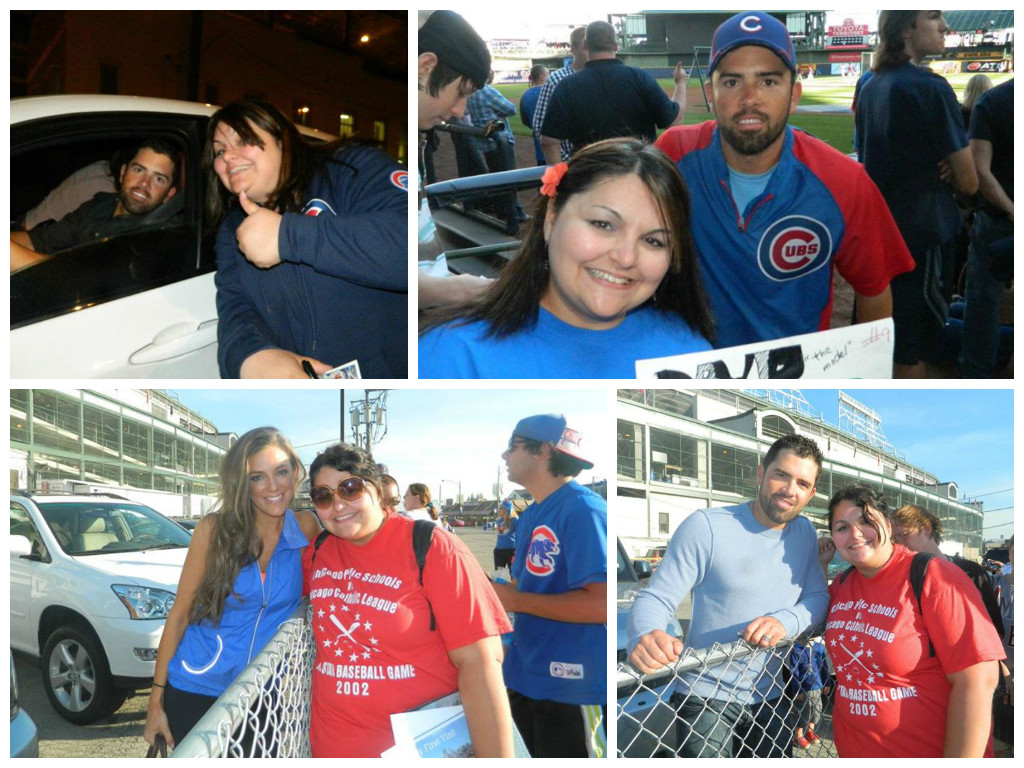
David was always good to the fans, especially the kids waiting for his autograph and to get photos. Also to the grown-up women who waited, mostly me. Here are some examples.
Then I met his wife. Like most women, I automatically distrust beautiful women. Kim DeJesus was the perfect target for my disgust. Of course I would hate her! I can't begin to describe her beauty in a way that would do her justice. Just look at her: I think you can probably tell which one she is.
But I couldn't hate her. I do not pretend to know her, but I have talked to her enough times to know that she is just as good as she is beautiful. She and David spent countless hours organizing fundraisers for many different causes. She always had kind things to say to her growing list of (mostly male) fans, and she always had kind things to say to me. I found out she grew up in the Chicago area, and she, too, had gone through some baseball crushes. And now she was married to possibly the most beautiful man to ever wear a Cubs uniform.
Even though she possessed an otherworldly beauty, somehow you could imagine that she was your best friend from grade school. When she talked to me, it was as if we were on the same level, and I was not just an ogre talking to the fairy princess. She was more beautiful than any woman I had ever met, but she was also a mom who loved posting photos of her baby boy, and a wife who was still overwhelmed by how handsome her husband is. She talked about being a klutz, having acne, being self-conscious--as if someone that perfect could ever have anything to be self-conscious about!
They're gone now. I wish they were still here. It's difficult to imagine Wrigley without them. But now David will play for a contender. Kim will fit in just fine with the new baseball wives, because how can you not love her? I'll keep in touch with her instagram photos and his headlining baseball stories.
I have watched enough of my favorite players leave the Cubs that I know I should be desensitized to the whole deal. Scott Hairston said to me, "I guess it's just business, right? I guess we're supposed to deal with it." But I could tell in his eyes that he didn't really think that.
I don't know what kind of hope we Cubs fans are supposed to have, how far we are supposed to look to the future for "THE SEASON" that will be the one that's supposed to count. David would've helped us for many years to come. Kim would've organized enough fundraisers to keep the Cubs active in the community for a decade. They were new Cubs, but they were older than most of the Cubs, and in many ways it feels like they've been here forever. And now, they're gone.
I will never forget the standing ovation David got when he stepped to the plate to pinch-hit in his first at bat as a National. Why did he get the ovation? He didn't have the highest batting average. He wasn't our best fielder. He wasn't the fastest guy. How did this guy get an ovation from the least forgiving, most critical fans in baseball?
Maybe because he represented what every Cubs player should be. Not just the physical picture of what we want in a player, although he does have those undeniable good looks, but the moral idea of what a player should be. A hard worker who gives everything on the field, no scandals off the field, just an athlete with a family that means everything to him, a Christian guy who doesn't beat the fans over the head with the Bible, but who quietly exhibits its principles in the way he plays. In many ways, David DeJesus was an average player with average statistics except for a ridiculous on-base-percentage, but in many more ways, David DeJesus was someone whose leadership and work ethic will be impossible to replace, and whose loss will be felt keenly on the Cubs and in our city.
With the loss of the DeJesus family, Wrigley is far less beautiful. Games will be less exciting. But I don't know a Cubs fan in the world who won't root for David no matter where he goes--Washington, Tampa Bay--back to Chicago? Wherever.
Good luck, you beautiful, good, dear people. I'm thankful for the time I had to watch you play and to interact with you both. Many, many blessings for you as you embark on this new path. You will be dearly missed. And, Kim, keep the kale recipes coming.
Subscribe to:
Posts (Atom)